
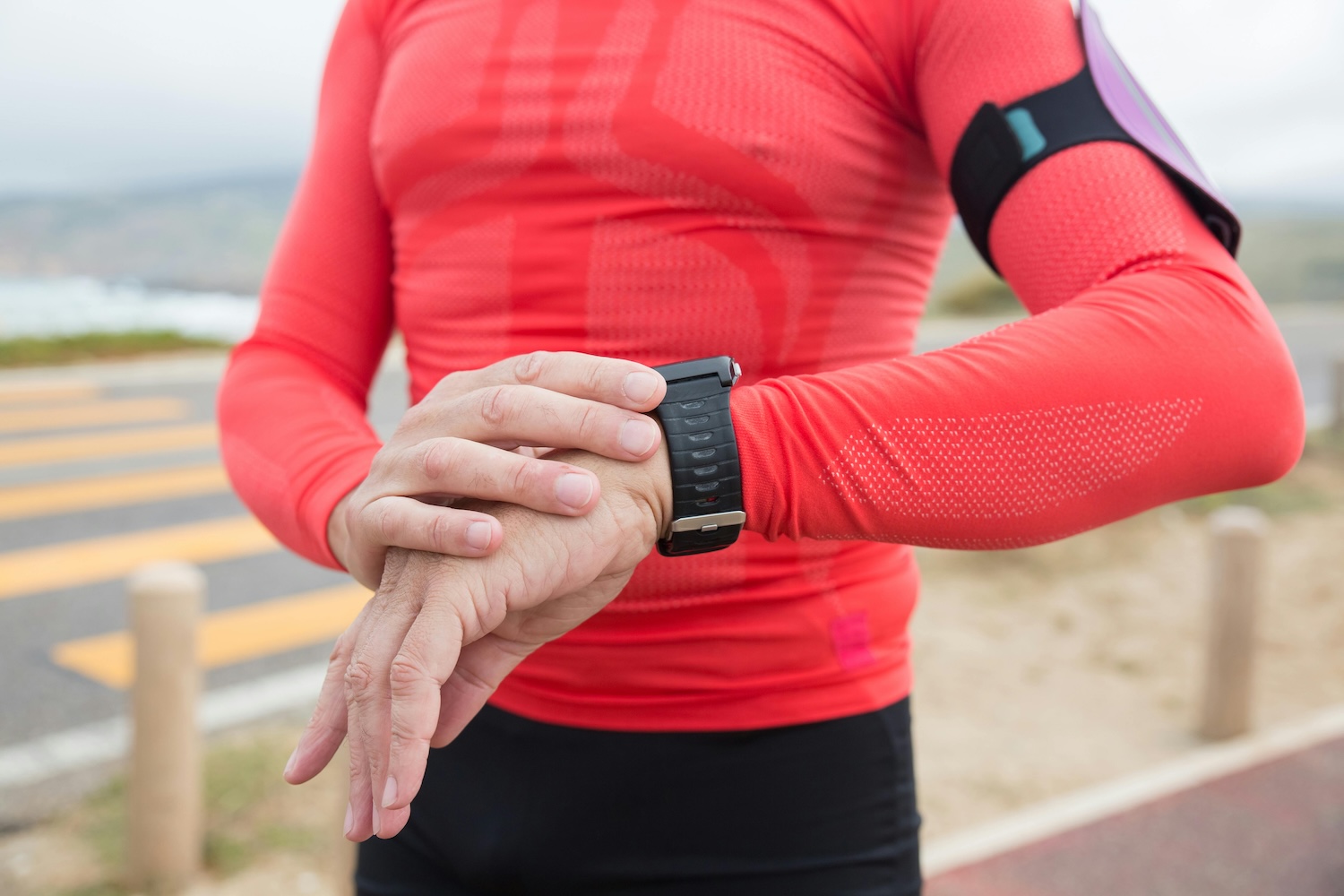
Heart Rate Monitor Training for Walkers — What You Need to Know
This article was originally written for Walk Magazine in 2008 by Michael Roth and updated in 2026. Michael is the USATF Vice Chair for Race Walking and one of the most knowledgeable people I know on the subject. I think you’ll find it really useful.
—
Much has been made over the last several decades on the benefits of working in your appropriate heart rate zones so that you can maximize your exercise benefits and ensure that you are exercising at the appropriate intensity. The most efficient method to do this is by using a heart rate monitor (HRM) while you are training. But just how do I get this technology to work for me and how will it benefit me in my walking, or other exercise plans?
Before you go out and purchase a HRM, you need to know a bit more about your body and how it works during exercise. Before we deal with that, let me dispel a myth. Your age has nothing to do with your ability to exercise at any intensity level or range of heart rates. The formula of “220 – Your Age” to figure out your maximum heart rate is based on solid science … fiction. Everyone’s body has a current range of efforts he or she can handle and an upper limit that can be achieved. In my mid 50s, I can sustain long/hard efforts with my HR in the mid 180s. The formula would indicate that to be above my maximum HR, not something achievable in practice and competition, while still permitting normal recovery. Again, everyone has different abilities.
There are a few terms that you need to understand that will make heart rate training and HRMs easier to understand and their value more apparent. The terms to know and understand are Aerobic Base (AB), Anaerobic Threshold (AT) and Lung Capacity (VO₂ Max).
Aerobic Base
Many times you’ve heard about the importance of building your base in training. You do lots of miles at an easy to moderate pace to make you stronger for the longer events. But what is your AB, really? Scientifically, it is the last point at which you are burning fat at least 50% of your utilized fuel consumption during exercise. Everyone has a heart rate where this occurs. The more fit you are, the higher the number. Ideally, this should be a heart rate and the corresponding pace that you can complete a 20 km or half marathon event.
Anaerobic Threshold
This point is where you get really inefficient at exercise and it can be downright uncomfortable for those who ignore speed work or are just generally unfit. Why is it so hard to exercise at this intensity? Basically, because this is where the body can no longer metabolize (use) fat as a fuel during exercise. The body has no other choice but to use mostly sugar because it needs energy faster than you can break down fat. Part of the reason for this is you are reaching the limits your body has in bringing in oxygen to burn the fat. To figure out the heart rate or pace of your AT, most people need to race a 3000m to 2-mile event. Highly conditioned athletes can race at this level for up to 10 km.
Lung Capacity
The lungs are muscles, and like most, they have a limit to what they can do. This is called the VO₂ Max. What this refers to is a formula that tells us the limits of how much oxygen they can take in at any one time. The higher the number, the better the function. Why is this such a factor in walking? Very simply, the lungs take in O₂, send it to the blood, which takes it to the muscles, where it is brought to the mitochondria (power plants of the muscles) and is used to burn fat for energy. The more oxygen the lungs can take in, the more work the muscles can do. The average U.S. woman has a VO₂ Max of about 36, a U.S. man around 45. Olympic race walkers are more likely to be in the high 70s to low 80s. Now you understand why they are so much faster than the rest of us.
Without getting into too much detail on different training philosophies and methods, let’s just say that the intent is to maximize all of the three training effects (AB, AT, and VO₂ Max) by spending time at a variety of intensities. It is a downright error in judgment to always train at the same pace or effort level, regardless of the event you are working toward or whatever your other fitness goals may be. This will only ensure that you get really good at one thing, at the exclusion of the others. It will also ensure that you never reach your maximum potential for fitness or performance.
What I recommend that everyone do is have an assessment done of their current fitness so that the state of their physiology can be determined. This can be as simple as doing a timed effort over 3000m and then matching your performance with one of many performance tables to figure out your fitness level. If you are interested in really getting the details on your inner workings, spend the time and money to get a lab test done that will give you an evaluation of your AB, AT, and VO₂ Max. Many universities will do this for a reasonable fee and some gyms have also started using these tests, too.
How to Buy a Heart Rate Monitor
Before you buy anything, check what you already own. Today, heart rate monitoring is built into many popular smartwatches and fitness watches including Apple Watch, Fitbit, Garmin, Polar, and Coros. If you already wear one of these, you may have everything you need to start heart rate training. Simply look up how to access the heart rate feature on your device and you’re ready to go.
All of these watches will also connect directly to apps on your smartphone so that you can upload your training to many websites. If you didn’t post your workout on Strava, then it didn’t happen at all.
If you don’t own a fitness watch and are ready to invest in one, you have two main options:
A chest strap remains the most accurate choice. It connects to your smartphone and fitness apps via Bluetooth for reliable, real-time data.
A wrist-based or armband monitor is more convenient and comfortable for everyday use and will work well for most walkers. While slightly less precise than a chest strap, today’s wrist monitors are remarkably accurate for general training purposes.
Whatever level of heart rate monitor you choose, make sure you get a product that will be durable and grow with you as your interests and abilities change over time. Prices vary widely, so shop around and choose one that fits your budget and training needs. Getting one because it’s on sale will only lead to frustration when you outgrow it or it fails a year after buying it. Just like every other piece of gear you buy for your training, your heart rate monitor buying decision should be treated like the important investment that it is.
Recommended Reading
If you want to dive deeper into heart rate training, John L. Parker Jr.’s book Heart Monitor Training for the Compleat Idiot is a great place to start. Despite the title, it’s a serious guide to training smarter. Parker’s core philosophy is simple: most runners (and walkers) train too hard on easy days and not hard enough on hard days. Using a HRM to keep your recovery runs at 70% of your maximum heart rate is the foundation of his system. He also debunks the “220 minus your age” formula for calculating maximum heart rate. It’s an easy read that will change the way you think about training.
—
Roth, the current USATF Vice Chair for Race Walking, is USATF Level 2 Certified Coach in Endurance & Youth/U20 along with the Specialty Certificate in Race Walking, and is a World Athletics Bronze Level Race Walk Judge. Roth is also the Coach of the Raleigh Walkers and manages the USA Race Walking & HS Race Walking sites
Raleigh Walkers – https://www.raleighwalkers.com
USA Race Walking – https://usarw.racewalk.com
HS Race Walking – https://www.hsrw.net
HS RW YouTube – https://www.youtube.com/hsracewalk
(192)



Comments
I’ve tested many tools, but this Nino Game link stands out for its seamless mobile access. The strategic balance of chance and skill here is remarkable. Check out nino game slot download to experience true mastery today.
Just found this platform blending ancient strategy with modern fun! The 五行 game philosophy really resonates with me. Check out jl69 download apk to start your journey today!
Love the deep dive! Thinking about those color gradients, it reminds me how much visual flair matters. Check out phl999 com for more vibrant action; it’s a visual treat!
The structural simplicity noted in the product overview is key; understanding RTP and volatility before diving in is crucial for any serious player. For a deeper dive into the mechanics, check out dbok ভিআইপি.
w921pi
vw85q0
Really interesting points! It’s great to see platforms like lucky cola vip prioritizing player well-being alongside entertainment – responsible gaming is so important. The focus on a balanced experience seems key for long-term enjoyment! 🤔
That’s a great point about balancing accessibility with advanced systems – crucial for keeping all players engaged! I’ve been checking out phlwin super ace and their approach seems solid, offering something for everyone. Definitely worth a look if you’re seeking new gaming experiences!
Every day is a new beginning
Totally digging the breakdown! For newbies, understanding the core mechanics is key. Check out this guide: 1111 angel number ভিআইপি. It really clarifies the platform’s appeal! 🌴🍹
Hahahaha You are so good
Digging into the structural elements here is key; pure surface-level review misses the statistical undercurrents. For a deeper dive into platform mechanics, check out X Games download. It gives good context!
That’s a solid point about team dynamics! Seeing platforms like okayplay games build communities is cool – adds another layer to the excitement. Wonder if that impacts betting strategies too? 🤔
Honestly, I expected fluff, but the depth here is solid. The behavioral aspect analysis is key, not just the features. Check out ne88 game for context; it adds necessary nuance.
The focus on pacing is key; it’s less about the flash and more about the flow. Seeing the integrated system at 555bl club confirms they understand strategic depth, not just quick bets. Solid read!
Roulette’s allure is fascinating – that blend of chance & probability! Seeing platforms like ninong gaming download apk prioritize secure, easy access (like mobile apps!) for Filipino players is great. Quick deposits via GCash are a nice touch too!
The emphasis on personalized biometrics over generalized formulas is a core lesson in systems thinking. This principle-that individual variables dictate outcomes-is crucial whether optimizing a runner’s heart rate or navigating complex, high-stakes platforms like 111bed ডাউনলোড 111bed ডাউনলোড.